
Casino Reviews

Casino Reviews

How to Evaluate Casino Payment Options for Secure Transactions

Depositing money at an online casino takes only a few clicks, but a convenient transaction is not necessarily a secure or practical one.

Payment information is valuable, and a poorly protected account can expose both personal data and available funds. Understanding how to evaluate casino payment options requires examining the complete transaction journey.

Players should identify who processes the payment, what data is collected, how the account is authenticated, and whether withdrawals are supported through the same channel. They must also consider fees, verification, transaction limits, and dispute procedures.

Debit cards, e-wallets, bank transfers, prepaid services, and instant banking systems handle information differently. An e-wallet may reduce the number of businesses receiving card details, while a direct transfer can provide a clear banking record.

However, no payment category is automatically safe in every situation. Security depends on the casino, payment provider, user account, device, and transaction process working together.

A player should therefore verify both the operator and the payment channel before sending funds or uploading financial documents.

Understand the Complete Payment Flow

A casino payment usually involves more than two parties. The transaction may pass between the player, casino, payment gateway, processor, bank, card network, or digital wallet provider.

This creates several points where information must be transmitted and verified. Secure third-party gateways can allow businesses to outsource sensitive payment processing, but incorrect integration may expose transactions to fraud, payment manipulation, or false confirmation messages.

Look at the URL when a casino redirects you to an external payment page. The domain should belong to the named provider, use HTTPS, and display no browser security warning.

After completing the transaction, return to the casino through its official website rather than an unknown link contained in a message.

Check the Security of Card Payments

Cards are widely recognized and often convenient, but users should understand how payment data is handled. A casino should not expose full card details in account histories, emails, or support messages.

PCI DSS establishes baseline requirements for organizations that store, process, or transmit cardholder data. The standard covers entities throughout the payment chain, including merchants and service providers.

A reference to PCI DSS can be a positive sign, but a logo alone is not proof of compliance. Licensing, domain verification, secure website configuration, and operator reputation still need to be examined.

Never send a complete card number, password, PIN, or card security code through ordinary email or live chat. When payment evidence is requested, follow the operator’s instructions for masking details that are not needed.

Evaluate E-Wallets and Instant Banking

An e-wallet can provide a separate layer between the casino and a card or bank account. It may also offer quick transaction notifications and centralized activity records.

However, players should check wallet funding charges, withdrawal fees, account-verification rules, supported currencies, and regional availability. A casino may accept an e-wallet deposit while excluding that method from a bonus or withdrawal.

Instant banking services can connect directly to a participating bank and may remove the need to enter card information. Their usefulness depends on supported institutions, transfer limits, and withdrawal functionality.

Do not assume that “instant” means the same processing time in both directions. Casino review periods and banking procedures can still delay cashouts.

Use Strong Account Authentication

Payment protection depends heavily on account security. A criminal who gains control of a casino or e-wallet account may attempt to change personal details, deposit stolen funds, or redirect withdrawals.

Use a unique password that is not shared with email, social media, or other gambling accounts. Reused credentials can allow attackers to enter multiple services after one password is exposed.

Enable multi-factor authentication for the casino, email account, bank, and e-wallet whenever it is available. OWASP explains that authentication can involve passwords, security tokens, biometrics, and other factors used to establish identity.

Also activate login and transaction alerts. Early notification of an unfamiliar payment or account change can make it easier to contact the relevant provider quickly.

Review Privacy and Data Collection

Casinos may collect identity documents, payment information, transaction history, device details, and source-of-funds evidence. Read the privacy notice to understand why the information is collected and with whom it may be shared.

Use only the secure upload area linked from your verified casino account. Be cautious when documents are requested through messaging applications, personal email addresses, or unfamiliar file-sharing websites.

Consider how much financial separation you prefer. Some players use a dedicated bank account or e-wallet with a limited balance for entertainment transactions, making records easier to review.

This approach does not remove gambling risk, but it can improve budgeting and reduce the amount exposed if an account is compromised.

Examine Verification and Fraud Controls

Verification is not automatically a warning sign. Regulated casinos may need to confirm identity, age, payment ownership, and the legitimacy of transactions.

Problems arise when requirements are vague, repeatedly changed, or introduced only after a withdrawal request despite being reasonably foreseeable earlier. UK rules state that operators should not use cashout requests as the first opportunity to demand information that could have been collected sooner.

Before depositing, ask what documents may be needed and whether the selected payment method requires additional proof. Ensure the name and personal details on the casino account match those registered with the payment provider.

Avoid third-party payments. Using another person’s card, wallet, or bank account can trigger fraud controls and complicate withdrawals.

Check Support and Dispute Procedures

A trustworthy payment system should include a clear process for reporting failed deposits, duplicate charges, unauthorized transactions, and delayed withdrawals.

Test customer support before depositing by asking a specific payment question. A useful answer should identify expected processing periods, fees, required documents, and escalation procedures rather than providing a generic response.

Keep transaction IDs, screenshots, statements, support conversations, and copies of the terms that applied when the payment was made. These records may be valuable if the casino and payment provider show different transaction statuses.

For MGA-licensed operators, players can use the regulator’s formal complaint channel after attempting to resolve the matter directly with the casino.

A secure casino payment option is more than a familiar logo on a deposit page. Players should examine the full payment flow, data-security standards, website domain, authentication features, privacy practices, verification rules, and complaint procedures.

Choose a method that supports clear transaction records and reliable withdrawals. Use accounts held in your own name, enable multi-factor authentication, and never share passwords or one-time codes with anyone claiming to represent the casino.

Before transferring money, verify the operator’s licence and read the cashier terms carefully. Start with a modest amount within a fixed entertainment budget and confirm that the payment process works as described.

Strong personal security habits remain essential even when the casino and payment provider use recognized technical safeguards.

Casino Reviews

Casino Licensing, Security, and Reputation: How to Verify a Site

Choosing an online casino should involve more than comparing bonuses, game counts, and payment methods.

Before depositing money or uploading identification documents, players need to know who operates the site, which authority supervises it, and what protections are available if something goes wrong.

This is where licensing, security, and reputation become essential. Licensing creates a legal and regulatory relationship between the operator and an authority. Security reduces the risk of stolen credentials, intercepted data, or unauthorized account access.

Reputation provides evidence of how the casino treats customers after registration, particularly during verification and withdrawal.

This article offers casino licensing, security, and reputation explained as a practical verification process. Rather than assuming that every licence badge or review score is genuine, it shows how to confirm details through original sources.

The process does not eliminate the financial risks of casino games. It helps users avoid unverified operators, misleading licence claims, weak account protection, and platforms with persistent service problems.

Spending ten minutes on verification before depositing can reveal more than hours spent browsing promotional pages.

Check the Regulator and Its Jurisdiction

The first question is not simply, “Does this casino have a licence?” A better question is, “Does this licence authorize the operator to serve customers in my location?”

Online gambling laws are jurisdiction-specific. An operator may hold a licence in one country while lacking permission to market or provide services somewhere else.

Players should therefore review local rules and confirm that the regulator named by the casino covers the relevant market.

Established regulators normally maintain public information about licensees, consumer protections, complaints, and enforcement.

The UK Gambling Commission licenses businesses serving customers in Great Britain, while the Malta Gaming Authority maintains a register containing licensee names, approved URLs, authorization status, and gaming services.

A vague phrase such as “internationally licensed” is not enough. A legitimate operator should identify its legal company, regulator, licence details, registered address, and applicable terms.

Match the Casino Domain to the Public Register

Fraudulent websites may copy the name, logo, or licence number of a legitimate company. For this reason, verifying only the licence number is incomplete.

Compare the Exact Information

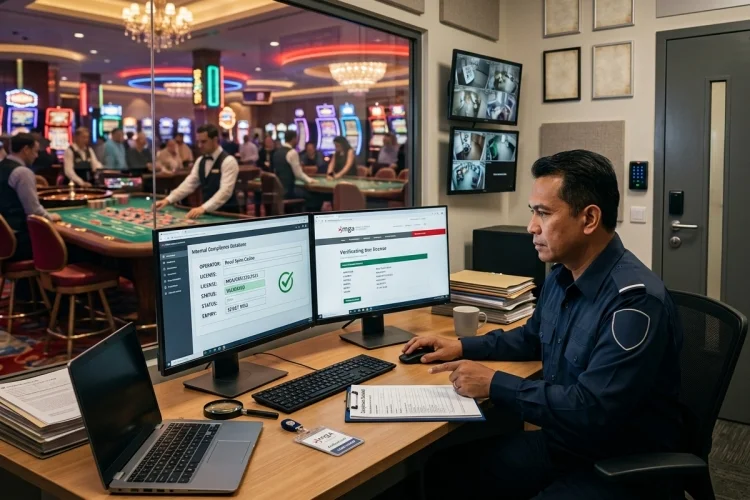
Locate the operator’s legal name and licence details in the footer. Search for the business in the regulator’s register and compare the exact website address with the domain in your browser.

Check whether the licence is active and whether it covers remote casino games. A company might have authorization for software supply or another gambling product without holding the permission needed to operate the casino being advertised.

The Gambling Commission advises consumers to check its public register and requires licensed businesses to provide a link to their licence information. The MGA register similarly allows searches by company, URL, authorization status, and service type.

Typing the regulator’s address independently is safer than trusting an unfamiliar footer link that could lead to an imitation page.

Inspect Website and Account Security

A secure connection is a basic requirement for any site that collects personal and financial information. Confirm that the registration, account, deposit, and withdrawal pages use HTTPS and that the browser does not display certificate warnings.

Transport encryption helps prevent data from being read while it moves between the user and the server. OWASP recommends sending credentials through encrypted channels and protecting sensitive information with correctly configured TLS.

The casino should also provide sensible account controls. Password-reset messages should not expose passwords, sessions should expire after inactivity, and users should receive notifications about important account changes.

Multi-factor authentication is particularly valuable because a stolen password alone may not be enough to access the account. OWASP describes MFA as a leading defence against password-based attacks.

Customers must also protect themselves by avoiding reused passwords, fake casino applications, public Wi-Fi during payments, and unsolicited links sent through messages.

Review Game Fairness and Technical Testing

A legitimate online casino should provide understandable game rules, payout information, and access to approved software from identifiable providers. Outcomes must follow the game’s stated mathematical model.

In regulated systems, technical standards may address random number generation, result determination, player-account functionality, game information, and system security.

The UK Gambling Commission’s remote technical standards include fairness requirements and security controls based on parts of ISO/IEC 27001.

The Commission also maintains approved test houses and requires independent testing where specified. These testing arrangements assess whether gambling products comply with regulatory standards.

Testing does not mean that a game is likely to produce a profit. It means the software is evaluated against defined technical and fairness requirements. Casino games still include a mathematical advantage for the operator.

Examine Payments and Customer-Fund Protection

Before depositing, read the cashier and withdrawal policies. Important details include minimum and maximum transactions, processing times, fees, supported currencies, identity checks, and whether withdrawals must return to the original payment method.

Pay attention to how customer balances are protected if the operator becomes insolvent. A licence does not always mean every deposited dollar is insured or fully separated from business assets.

For Great Britain, gambling companies holding customer funds must disclose their protection arrangements and rating. The regulator identifies different levels, and a “not protected” rating means money may form part of the company’s assets during insolvency.

Avoid leaving unnecessarily large balances in a casino account. An online casino wallet should not be treated like a bank account or long-term savings product.

Analyse Reputation and Complaint Handling

Search for the casino’s legal company name, not only its brand. This can reveal whether several websites are operated by the same business and whether complaints follow a broader pattern.

Prioritize detailed reports that explain the transaction, dates, communication, and outcome. Be cautious with anonymous accusations that provide no evidence, but also avoid dismissing repeated complaints involving the same issue.

The strongest reputation signal is often how an operator resolves problems. Look for accessible support, a documented complaints process, realistic response periods, and an independent escalation route.

UK-licensed operators must provide an Alternative Dispute Resolution service for unresolved disputes.

Current Gambling Commission guidance states that consumers generally use the operator’s procedure first and may approach an ADR provider after eight weeks or when they receive a deadlock response.

MGA-licensed customers can also submit complaints through the Authority’s formal player channel after attempting to resolve the issue with the operator.

A trustworthy casino should survive several independent checks. Confirm that the legal operator, licence status, authorized activities, and exact domain match an official regulatory register.

Inspect HTTPS protection, account controls, game-testing information, payment terms, and customer-fund disclosures. Then study the operator’s history.

Repeated withdrawal disputes, unclear verification demands, copied licence information, or an absent complaints process can outweigh an attractive promotion.

Perform these checks before depositing or submitting personal documents. Save copies of important terms, transaction records, and customer-support conversations in case a dispute occurs.

Most importantly, choose only operators legally authorized for your location and set deposit, loss, and time limits before starting. Verification improves platform selection, but responsible limits remain the most important personal protection.