How Live Casino Studios Synchronise Video, Bets and Game Outcomes
A live roulette table looks surprisingly simple from the player’s screen. A dealer opens betting, chips appear digitally, the wheel spins, the ball lands, and winnings are settled within seconds. Behind that smooth sequence, however, several independent systems are working at the same time.
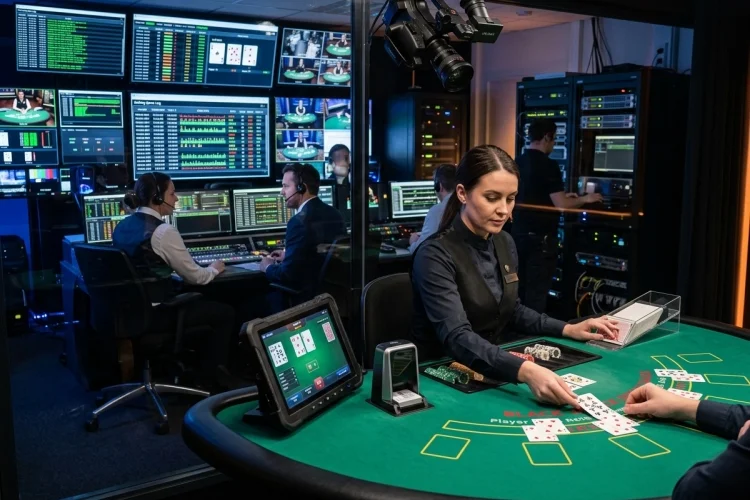
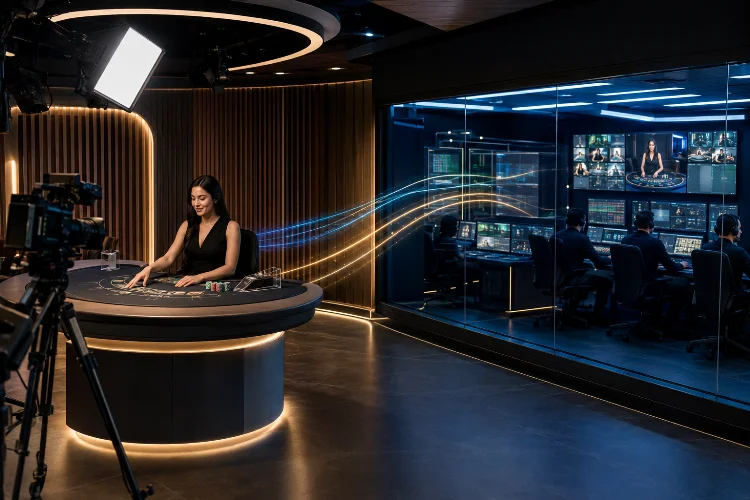
Modern Live Casino Studios have to keep physical table activity, video broadcasting, betting interfaces, game-state data, and transaction systems aligned. The challenge is not merely streaming a dealer with a camera.
The platform must also know exactly when betting begins and ends, which wagers belong to each round, what physical outcome occurred, and when settlement can safely happen. Independent testing laboratories even include synchronicity testing when evaluating live dealer environments.
A Live Table Produces Two Types of Information
The easiest way to understand a live casino system is to separate what the player watches from what the software needs to know.
The video layer shows the physical game: dealers, cards, wheels, balls, equipment, and the surrounding studio. Multiple cameras may be used to create different angles. Evolution, for example, describes some live roulette products as using multi-camera studio setups and close-up views.
At the same time, the platform requires structured data.
That data may include the table identifier, current round, betting status, card values, winning number, timestamps, and settlement instructions.
Video tells the player what the game looks like.
Game-state data tells the system what the game is doing.
Keeping those two layers aligned is the central synchronisation problem.
Betting Windows Create the Timing Framework
Every live round follows a controlled sequence.
A simplified roulette round might look like:
Betting open → wagers accepted → betting closed → wheel result → result verified → bets settled
Players mainly notice the countdown timer, but the backend is tracking considerably more information.
Once betting closes, wagers submitted after the deadline must not be treated as part of the active round. The physical event then takes place, and its result must be associated with the correct betting cycle.
This sounds obvious until network latency enters the picture.
A player may be hundreds or thousands of kilometres away from the studio. Their video stream, interface commands, and server communication do not necessarily travel at identical speeds.
The authoritative betting status therefore needs to be controlled by backend systems rather than simply by what appears on a player’s screen.
That distinction helps prevent timing ambiguty.
Physical Outcomes Must Become Digital Game States
A dealer can look at a roulette wheel and immediately see where the ball has landed.
A software platform needs the result in structured form.
Depending on the game and provider, live casino equipment can work with scanners, recognition technology, table electronics, dealer interfaces, or similar mechanisms to record what happened physically.
The important point is not that every studio uses an identical technical architecture. They do not.
The important point is that an observable physical event has to become an authoritative digital outcome before transactions can be finalised.
Independent testing of live dealer systems covers technical systems and synchronicity precisely because the physical and digital components need to correspond reliably.
A card displayed on-screen cannot belong to the wrong hand.
A roulette result cannot accidentally settle wagers from the previous round.
That mapping between event and round is fundamental.
Why Timestamps and Round IDs Matter
Imagine a studio running dozens of tables continuously.
A number such as “17” is not enough information for the backend to settle roulette wagers.
The platform also needs to know:
Which table generated the result?
Which round was active?
When did betting close?
Which wagers were accepted?
Was the outcome confirmed?
This is why organised live gaming systems rely on identifiable game states and records rather than treating events as isolated pieces of information.
From an engineering perspective, round identifiers and timestamps help connect separate activities into one auditable sequence.
They also become valuable when something goes wrong.
If a player disputes a settlement, operations teams need to reconstruct what happened. Regulators such as the UK Gambling Commission require live dealer operations to be independently auditable.
Auditability depends on having enough reliable information to reconstruct the round rather than relying on memory.
Video Latency and Game Data Are Managed Differently
Video is relatively heavy.
A continuous HD stream contains far more data than a message saying “betting closed” or “winning number 24.”
For that reason, video and game-state messages can travel through different technical paths before being combined inside the player’s interface.
A compressed video stream may arrive fractionally later than lightweight game-state data.
The system therefore has to make the overall presentation feel coherent even when those components are not physically transmitted in exactly the same way.
This is one reason live studio testing includes synchronicity rather than only video-quality checks.
The aim is not necessarily to make every packet arrive at exactly the same millisecond.
It is to make sure the user never receives contradictory information about the active round.
That differance matters.
Settlement Happens After the Outcome Is Confirmed
Once the physical result has been translated into a valid game outcome, the transaction layer can evaluate player wagers.
Suppose a roulette result is 24.
The system can compare that result with bets placed on straight numbers, colours, dozens, columns, odd/even markets, and other eligible selections.
Winning and losing bets are then processed according to the game’s rules.
The transaction process needs to remain linked to the correct table and round.
A premature settlement could become problematic if the physical outcome were later found to have been misread or the round declared invalid under operating procedures.
This is why result confirmation is not simply an animation shown after the wheel stops.
It is part of the operational flow between physical play and digital accounting.
Live dealer regulations focus on fairness and auditability, reinforcing the importance of controlled procedures rather than instant but unverifiable settlement.
Surveillance Adds an Independent Record
Live casino studios are not monitored only through the same broadcast shown to players.
Regulatory guidance can require surveillance capable of recording dealer activity and providing enough detail to confirm whether dealing procedures and game rules were followed.
That creates another layer of verification.
Player-facing video is designed for entertainment and clarity.
Operational surveillance is designed for supervision, security, and investigation.
If an unusual event occurs—a misdeal, equipment issue, or disputed sequence—studio teams may need information beyond what appeared in the public stream.
This separation strengthens the overall infrastructure because no single display has to serve every operational purpose.
It also makes the sytem easier to audit.
What Happens When Synchronisation Fails?
Real-time systems have to assume that interruptions can occur.
A camera can fail. Network quality can drop. A scanner may not recognise an event correctly. A table device may temporarily disconnect.
Good architecture therefore needs exception-handling procedures.
The system might pause the round, prevent settlement, request dealer confirmation, or route the incident for review depending on the provider’s design and applicable rules.
Independent testing organisations evaluate live dealer systems, premises, staffing, technical components, and synchronicity rather than assuming normal conditions will exist forever.
That resilience is crucial.
A system is not reliable simply because it works when everything is perfect. It should also fail predictably when something unexpected happens.
Live Casino Studios synchronise video, bets, and outcomes by treating each round as a controlled digital workflow linked to a physical game. Video shows the action, while game-state data manages betting windows, results, and settlement.
Understanding these separate layers makes the technology easier to appreciate. When watching a live table, pay attention to how seamlessly those invisible systems stay aligned.